We LIVE here.







Have an idea for a design that's not available?
If you don't see what you want and have an idea, let us know and we'll discuss design options.
Shop By Collections
Nothing beats supporting your local community. Find merchandise from your corner of the county.





See Our Latest Blogs
Stay up-to-date with our latest insights, tips, and trends by diving into our newest blogs. Whether you're seeking industry expertise, marketing strategies, or product inspiration, our blog section is your go-to resource for valuable content.
The Lost State of Franklin: Greeneville’s Forgotten Capital
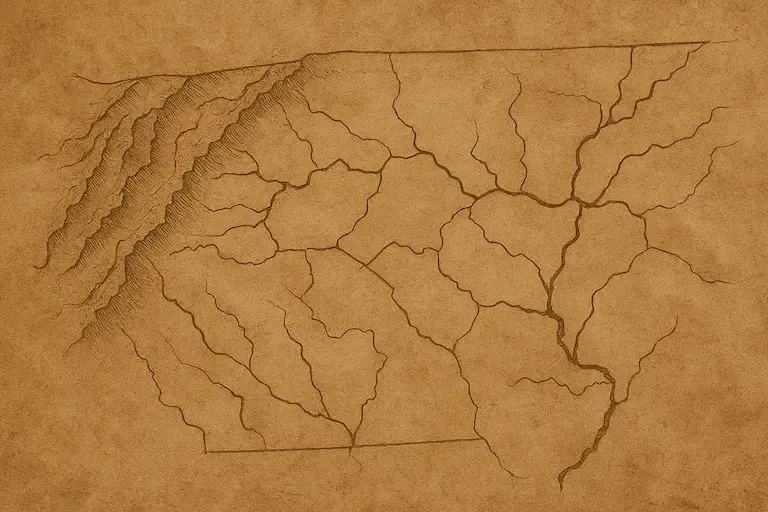
Did you know Greeneville was once the capital of a “lost” American state? It’s true – for about four years in the 1780s, this charming East Tennessee town served as the seat of government for the State of Franklin. The short-lived State of Franklin (named in honor of Benjamin Franklin) was organized in 1784 out of North Carolina’s western frontier and existed until 1788. It spanned much of what is now upper East Tennessee, from the Virginia border near Bristol down to present-day Blount County. While Franklin never officially became the 14th state, its legacy lives on in Greene County’s rich history and landmarks. In this article, we’ll explore how and why the State of Franklin was formed, Greeneville’s role as its capital, the colorful characters involved (like frontiersman John Sevier), why Franklin ultimately failed, and what remnants of that era you can still see around Greeneville today.
Born from the Frontier: Why Franklin Was Formed
In the wake of the American Revolution, settlers in the remote Appalachian regions felt distant and ignored by their state governments. The western counties of North Carolina (what is now Tennessee) were separated from the state’s capital by rugged mountains. In 1784, North Carolina decided (briefly) to cede its western lands to the Continental Congress to help pay off war debts. Local frontiersmen feared Congress might even sell their lands to foreign powers or that they’d be left ungoverned. When North Carolina changed its mind and rescinded the land cession a few months later, many settlers had already begun organizing their own independent state. Fed up with distant rule and anxious to secure their land claims, delegates from Washington, Sullivan, and Greene counties met in Jonesborough in August 1784. There, they declared their intention to form a new state, originally calling it “Frankland” (meaning “land of the free”).
Hoping to gain support from one of America’s most esteemed founders, the rebels renamed their proposed state “Franklin” in honor of Benjamin Franklin. (Franklin himself responded politely to Governor John Sevier’s letter but declined to get involved, noting he was “too little acquainted” with their situation.) By late 1784, the State of Franklin had set up a provisional government, even adopting a temporary constitution based on North Carolina’s. The people of the Franklin territory were determined to run their own affairs – “taxation without representation” wasn’t something these Revolutionary War veterans would tolerate after 1783!
Greeneville Becomes the Capital of Franklin
At first, Jonesborough hosted some of the early Franklin conventions. But by 1785, Greeneville was chosen as the official capital of the State of Franklin. The decision made sense: Greeneville was a central location on the frontier and safely distant from North Carolina’s direct influence. In December 1785, Franklin’s first legislature convened in Greeneville, marking the town’s brief moment in the sun as a state capital. That same year the delegates elected John Sevier – a celebrated local hero of the Revolutionary War – as Franklin’s governor. Sevier, already popular for his leadership in battle (he’d fought at King’s Mountain) and in local Indian conflicts, was the natural choice to lead the nascent state.
Under Governor Sevier’s leadership, Franklin began to function much like an independent republic. The Franklin legislature created new counties, set up courts, and even arranged treaties with local Native American tribes to secure more land for settlement. With hard currency scarce on the frontier, the State of Franklin adopted a barter economy – they allowed taxes and fees to be paid in goods like corn, tobacco, cotton cloth, apple brandy, and animal skins. (Legend has it Governor Sevier even accepted deer hides as payment for taxes!) For a time, Franklin was truly doing its own thing: it had its own laws, its own governor and legislature, and Greeneville at the center of it all.
Even as Franklin tried to solidify itself, it sought recognition from the United States. In May 1785, a delegation from Franklin submitted a petition for statehood to the U.S. Congress. Seven states voted in favor of admitting Franklin (initially under the name “Frankland”), but under the Articles of Confederation they needed a two-thirds majority (the approval of nine states) to create a new state. Franklin fell just short. Undeterred, the Franklin government continued operating on its own authority when Congress failed to act. For the next few years, Greeneville functioned as an unofficial state capital of a territory that the federal government and North Carolina did not officially recognize – a truly unique situation in American history.
Franklin’s Challenges: Rivals, Rebels, and Reality
Running a breakaway state in the wilderness wasn’t easy. Not everyone in the region agreed with the Franklin movement. A faction of locals remained loyal to North Carolina, led by Colonel John Tipton, who viewed the Franklin government as illegal. This split led to a rival government situation. By 1786, North Carolina had re-established its authority in the area by setting up its own courts and militia companies, even as Franklin’s officials were doing the same. Imagine having two governments at once! At one point, families in the region weren’t sure if they owed taxes to Franklin or to North Carolina – in fact, some were taxed twice. Tensions mounted as Franklin (the “Franklinites”) and the North Carolina loyalists each tried to assert control over the same territory.
Matters came to a head in early 1788 in an event often called the “Battle of Franklin” (really more of a skirmish). John Sevier and John Tipton’s feud turned violent when Sevier, as Franklin’s governor, attempted to reclaim property that North Carolina authorities had seized for taxes. In February 1788, Sevier led about 100 armed men to Tipton’s farm (near present-day Johnson City) to confront his rival. Tipton, backed by North Carolina militiamen, refused to yield. A brief gunfight ensued during a snowstorm, leaving a few men wounded and at least three dead. Sevier’s force retreated – the State of Franklin was literally in a shooting war with North Carolina’s faction, a dramatic climax to the power struggle.
By this point, Franklin’s hope for survival was fading. The Cherokee and other tribes had begun attacking frontier settlements, exploiting the colonists’ division. Franklin’s leaders grew desperate – at one point Sevier even explored the idea of seeking Spanish protection for Franklin, which alarmed U.S. and NC officials. North Carolina had also been offering an olive branch to Franklin’s residents: pardon for rebels and a promise to waive two years of back taxes if they returned to North Carolina’s fold. These incentives worked, gradually undercutting Franklin’s support. By late 1788, Franklin’s government had collapsed in all but name. Governor Sevier was even arrested for treason by North Carolina authorities (he was briefly detained in August 1788). However, Sevier’s old Revolutionary War comrades were sympathetic – the local sheriff actually helped him escape jail rather than see his former general put on trial!
Realizing the jig was up, Sevier and the last Franklin holdouts finally agreed to swear allegiance back to North Carolina in early 1789. The State of Franklin experiment was over. North Carolina reabsorbed the area, and in a gesture of reconciliation even seated John Sevier in the North Carolina legislature as a representative of Greene County. A chapter of history had closed – but a new one was on the horizon. In 1790, North Carolina ceded the same western lands (more willingly this time) to the U.S. federal government, leading to the creation of the Southwest Territory. By 1796, this territory would become the state of Tennessee – with none other than John Sevier elected as its first governor. In the end, Franklin didn’t survive, but it paved the way for Tennessee’s statehood, and its leaders like Sevier continued to shape the region’s future.
Visiting Franklin’s History in Greeneville Today
A replica of the State of Franklin capitol building stands today in downtown Greeneville, Tennessee. Built in 1966 based on old photographs and records, this simple log cabin memorializes the short-lived state’s government. Greeneville takes pride in this tangible piece of history, which sits just a block off Main Street (behind the library on N. College Street). The original capitol cabin where Franklin’s legislature met in the 1780s was unfortunately lost – it was dismantled and sent to Nashville for Tennessee’s 1897 Centennial Expo, where it mysteriously disappeared (local lore says it may have sunk on a barge during a flood). Thankfully, local historians and citizens rebuilt a replica log capitol in the 1960s, using some timbers from the 18th century, to ensure the “Lost State” would not be forgotten.
When you visit Greeneville today, you can step inside this replica capitol cabin and imagine the debates that once echoed within its log walls. Adjacent to the cabin, historical markers provide context about the State of Franklin and Greeneville’s role as its capital. The story also comes alive at the Nathanael Greene Museum (named for the Revolutionary War general for whom Greeneville is named), which houses exhibits on the region’s history – including the Franklin period. Around town, you’ll find other reminders: for instance, Greene County’s heritage sites and even local businesses embrace the Franklin name (nearby Johnson City has a “State of Franklin Road” and other Franklin-themed places as a nod to this history).
Conclusion: A Proud Legacy of a “Lost” State
The State of Franklin may have been short-lived and ultimately unsuccessful, but its legacy endures in Greeneville. This unique chapter of history showcases the independent spirit of East Tennessee’s settlers – folks who boldly tried to create their own state when they felt their voices weren’t being heard. For locals and newcomers alike, knowing that Greeneville was once the capital of an almost-state adds a sense of pride and intrigue to our town. It’s a great story to share: how our community played a pivotal role in a post-Revolution experiment in self-governance.
So next time you stroll through downtown Greeneville, take a moment to appreciate the little log capitol and the historic markers. They stand as reminders of Franklin’s bold adventure in democracy. The Lost State of Franklin might be a footnote in American history, but here in Greene County, it’s our footnote – a fascinating tale of determination, local leadership, and the frontier spirit. Whether you’re exploring the replica capitol, visiting the museum, or just chatting with locals about history, you’re connecting with the enduring story of Greeneville’s forgotten capital.
Enjoy your journey into the past – and spread the word that Greeneville once sat at the helm of the one and only State of Franklin, a legendary lost state that will never be completely forgotten in these hills.


Copyright© 2026 Greene TN - All Rights Reserved.
This site is not sponsored by or maintained by Greene County or the Town of Greeneville. It is a privately owned and operated website that is intended to provide information and merchandise vabout Greene County and its surrounding areas. The information on this site is provided for informational purposes only and should not be construed as legal, financial, or other advice.
Facebook
Instagram
Youtube