The airport overlay: tabled 3–1, not voted down
This was the second and final reading of the ordinance that passed first reading 3–1 on October 20, held as a public hearing. It would add an airport overlay district to the zoning ordinance, repeal the town’s 1967 airport zoning (Ordinance 962), and apply the new rules in the runway approach areas both inside town and in the county. Council member Matt Hensley moved to adopt it, and the motion died without a second. The mayor then asked for a motion to table, which a council member made and another seconded. The roll call was Angelo Botta, Flint Carter, and Tim Teague yes; Hensley no. Mayor Cal Doty said the town will schedule informational meetings and bring the ordinance back before the council, with the end of January given as the target. It was tabled, not turned down.
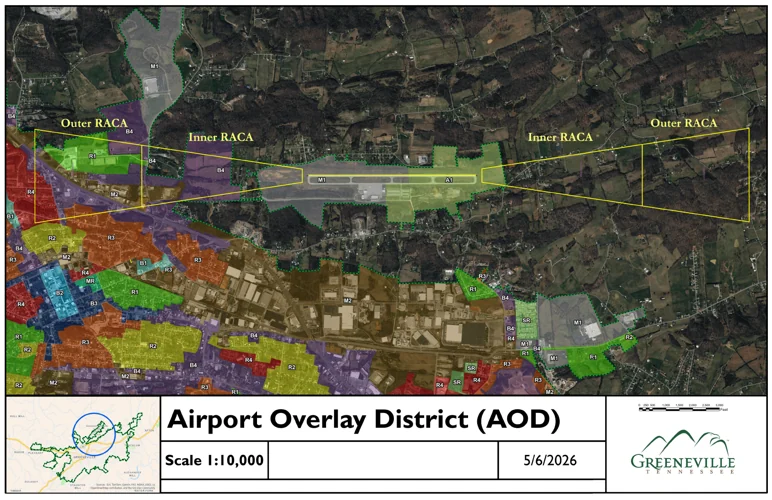
The town’s Airport Overlay District map (May 6, 2026).
The town’s case
Development Services’ Andy Broyles said a review of the 1967 ordinance found “compliance concerns with state law.” He cited Tennessee Code § 42-6-103, which says local governments “shall adopt, administer and enforce” airport zoning, and said the town attorney and MTAS Legal both backed replacing the old ordinance. Points he made:
- TDOT signed off twice. Its Aeronautics Division certified the text on July 10 and, after the county declined to take part, approved the town enforcing it in the county portion on October 6.
- The old ordinance is broader, and shaky. The 1967 rules use outdated maps and require permits across an 8,000-foot circle around the airport, covering much of town and part of the county. He said TDOT wanted that wider area kept, and the town negotiated the land use limits down to about the first mile off each runway end. He said the old height limits for structures and trees “just haven’t been enforced.” Town counsel questions whether the 1967 ordinance was properly extended into the county. If it were challenged and thrown out, he said, MTAS Legal’s opinion is that the town would have no airport zoning at all, putting it “in direct violation of state law” and possibly risking the airport’s license.
- The duty isn’t new. He said the town and county’s 1965 airport grant agreement already committed both to restricting nearby land to compatible uses, that TDOT asked for an updated ordinance in 2013, and that the 2017 comprehensive plan called for one.
- Farming. He said existing farming “is essentially grandfathered in,” and that a change of crop, or a new pond, would get “additional review” for bird hazards. He said he searched and found no list of prohibited crops anywhere in the state, and that the review procedure still has to be written, with UT Ag Extension and TWRA doing site assessments.
- Process. He called it “a year-long process with six public opportunities for input,” said the map hasn’t changed since May, and said the town asked the county three times to join. Appeals would go to the town’s Board of Zoning Appeals. Flight paths are an airport authority and FAA matter, not part of the ordinance.
- Liability. Council member Tim Teague asked about leaving the 1967 ordinance in place and said the town’s insurer, PEP, hadn’t said the town was liable. Finance Director Lora Young said staff met last week with the town’s liability specialist, who said the town’s exposure grows by not approving it, though “they cannot tell us to what extent.” She compared it to a brick on a sidewalk that the town knows is a hazard and doesn’t fix.
- Amending it means starting over. Hensley asked whether the council could approve it with conditions. Broyles said TDOT told him any material change would send it back through the Planning Commission and TDOT certification, likely six to eight months. He suggested passing it and amending later instead. Before the vote he asked that, if it were tabled, the council give “a detailed list of reasons why” so staff could address them.
What landowners asked for
Farmers and other landowners spoke against it or asked the council to table it. Several, including Brian Hartley, Patricia Stimple and William Ross, noted that county residents can’t vote for the council that would regulate their land. Among the concerns:
- Rules not yet written. Several asked who would decide what they may build or plant, by what standard, at what cost, and how to appeal. Brian Hartley, who said his family owns “just over 64 acres” with part of the farm in the overlay, said the airport reportedly received an unconditional state license in February 2025 and that airport authority minutes say an April state inspection found no issues, and asked what safety problem requires a vote now. His son Connor Hartley asked the town to work real examples through an actual parcel before voting: a small fishing pond, a crop change, a replaced grain bin, a parent splitting off a lot for an adult child when the building site and its access fall on different sides of the line, and what any required noise disclosure or easement would mean for a future buyer.
- Trees and heights. Mike Carlton asked who pays to trim trees and said the council “should know heights before you ever vote on this thing.” Malachi Carlton said the approach area’s starting width grew from 150 feet on an older plat to 500 feet. Jackie, whose family has owned its land since 1886, said he’d been told the land could be taken if he didn’t cut trees, and that he would sell his 30 acres if the ordinance passed.
- Property values. Bob Cutshaw said he had just listed 56 acres on Scott Farm Road for sale and expects to lose at least three quarters of a million dollars. William Ross said the ordinance restricting land use while saying it won’t affect property values “kind of contradicts itself,” and noted that Tennessee Ag Enhancement Program barn grants come with height specs. Larry Carter, who said he owns 18 acres at the airport, said the airport should buy or lease land it wants to control.
- The paper trail and county authority. Patricia Stimple, who said she lives in Chuckey, asked the town to publish the exact text and map TDOT certified next to the version before the council, explain which legal route lets it zone in the county, ask the county to join a public workshop, and post a searchable parcel map. She said the May draft applied within Greeneville’s town limits; Broyles said the documents and map submitted in May “are the same as they are now.”
- Funding. Greene County Commissioner Robin Quillen said she had searched and found nothing showing the airport would lose funding without the ordinance.
- Why now. Malachi Carlton asked whether the push is tied to a lawsuit over a proposed housing development at the end of the runway. Broyles said it is not, and that safety and the potential loss of airport funding prompted it.
What supporters said
Scott Niswonger said one of the first things he asked when he helped bring the John Deere plant here was whether it was within 15 minutes of the airport, and that “the state and the FAA will make a move on us” without it. A statement from Greene County Partnership president Jeff Taylor, read by former chairman John Levin, backed the overlay and said a company code-named Project Minty, expected in early 2027 with a $57 million investment and 150 jobs, chose Greeneville partly for airport access. Susan Loveday read a supporting statement from TEVET CEO Tracy Solomon. Pilot Bob Schooley said that with an engine failure right off the departure end he has to “look for a place that’s going to safely land.” Walter Stone, who came to the airport in 1970, said that back then “the state was trying their best to get us to zone the airport,” and that without zoning “we’re going to have a lot of headaches in the future.” A written comment from John Heard, who owns a lot in the outer area, didn’t object but asked the town to confirm its height limit, tree responsibility, and when the noise disclosure applies; the mayor said the town would respond.
The vote
Hensley, who also serves on the Planning Commission, said it had worked on the ordinance for a year with public workshops and that he would “take the butcher’s word for it” on the professionals’ advice. Another council member asked about “the urgency” and said “we do need to get on paper what exactly we can do and what structure height and stuff,” and Teague said, “let’s put it on paper.” Teague, who had asked to table the ordinance at first reading, said no one had been able to tell the council definitively whether the airport would lose grant opportunities without it. Earlier, he had pressed Broyles on farming and ponds and asked a pilot whether departing planes stay inside the approach area.
$1.25 million from town investments to cover a cash shortfall
Finance Director Lora Young said property tax collections are running about half a million dollars behind last year, and the town has spent about $500,000 on the Bernard Avenue sidewalk grant project while it waits for federal reimbursement, adding up to roughly a $1 million shortfall for now. The town holds $7.925 million in investments; its rainy day reserve was $8.1 million at the end of the fiscal year. The withdrawal, from funds held with LPL Financial through Andrew Johnson Investments, takes the reserve below the town’s 20% fund balance policy. Council member Matt Hensley said he was uneasy about that: “What’s the point of a policy if we’re not going to adhere to it?” Young said about 78% of property tax is paid through mortgage escrow, which mostly arrives from mid-December through early February, that she expects to repay the money by June 30 (the resolution allows 12 months), and that large capital purchases will wait unless there’s an emergency. The same resolution names signatories by name and title, as the investment firm requires. Asked by Hensley whether this was a temporary cash flow problem rather than a budget imbalance, Young said it was temporary. Approved on a voice vote (motion by Teague).
$25,000 for the Dickson-Williams Mansion
The council approved an appropriation from hotel-motel tax funds, which requires a budget amendment. The usual request is $15,000. The mansion’s director said it spent $63,000 this summer on guttering and the back porch roof, and porch rail, painting, and step repairs estimated at about $28,400 are now expected to run $5,000 to $10,000 more after crews found rot. Young estimated the hotel-motel reserve will be about $115,000 to $125,000 afterward. (Hensley, Teague.) The mansion hosts a holiday open house with free tours from 10 a.m. to 2 p.m. on Saturday, December 5.
Also approved
- Minutes of the November 3 meeting (Hensley, Carter), and two consent agenda items, which weren’t described aloud.
- A Roby Adult Center grant from the Dr. J.G. Hawkins Memorial Fund for the MyRide program, which has more than 40 riders and 17 volunteer drivers and focuses on medical trips. (Teague, Hensley.)
- Two Matrix treadmills for the Roby Center’s wellness room through the OMNIA Partners purchasing cooperative, paid by a state Department of Disability and Aging grant. (Teague, Carter.)
- Police ammunition, the department’s annual budgeted purchase through Gulf States Distributors on state contract. (Hensley, Botta.)
- A $14,000 change order for Advanced Cleaning and Restoration’s repairs at the Roby Center, added to the agenda at the start of the meeting, on top of the original $18,000 quote. Crews removing damaged plaster in the 1894 building found rotted window headers and holes in walls and floors in four rooms. About $9,800 comes from the state grant and about $4,500 from the center’s repair budget. The center is closed during the work, with activities moved to the Parks and Recreation gymnasium. (Teague, Carter.)
Worth noting
- Three proclamations. November is Family Court Awareness Month. The town honored the Niswonger Foundation for 25 years; Scott Niswonger accepted. And it declared WGRV Day for the radio station’s 80th anniversary: WGRV first signed on November 18, 1946, from the Brumley Hotel, now the General Morgan Inn, and has stayed in the Metcalf family for three generations. Ron Metcalf accepted.
- No regular public comment. The mayor said all of the evening’s comments were about the airport overlay, so they were taken during the hearing. See the events calendar.
The Greeneville City Council: Mayor Cal Doty; council members Angelo Botta and Flint Carter (Ward 1), Tim Teague and Matt Hensley (Ward 2). This plain-English recap is AI-assisted and unofficial. See the downloadable transcript and the Town of Greeneville’s official minutes for the record. Actions come from the meeting video; the town had not posted an agenda packet for this meeting, and ordinance details come from the October 20 packet. Speakers’ statements are their own and are reported, not verified. Speaker labels in the transcript are best-effort. For more local coverage, see the Government Meetings hub, Greeneville, and the Greene County hub.